

The wallpaper has just been installed, but when you look past it, there is a subtle ripple in the surface. Sometimes, by pressing the hand, one of the parts makes a sound. In many interior decoration projects in Tehran, the root of such a problem is not in the wall covering itself, but in the wood that cannot be seen behind it: the uneven, wet or disproportionate substructure with the final coating. Knowing the use of branched substructure wood will help you to decide on the stability and the method of its implementation before choosing the appearance of the work.
What is the use of branched substructure wood?
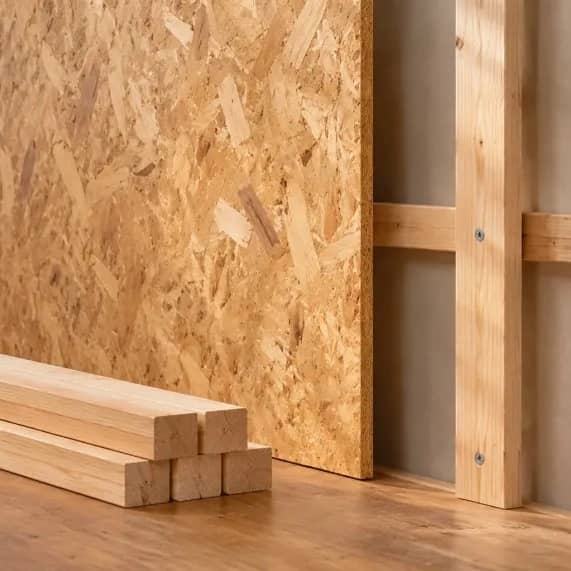
The branched substructure wood is used to make a level and connectable network between the wall or ceiling and the final cover. This network provides a place for screwing, compensates for the limited roughness of the surface and, if designed correctly, creates the necessary space for the passage of facilities or the implementation of details behind the cover.
"Twig" in this phrase usually refers to how the wood is supplied in certain lengths, not to the natural branch of the tree or a particular wood species. What determines the efficiency of the piece is the actual cross-sectional area after cutting or grating, the straightness of the branch, the moisture condition, the health of the screw location and its compatibility with the type of wall covering.
The most common uses are:
- Understanding wooden wall covering and lamps: Creating regular rows to connect the cover and adjust its level.
- Installing a panel cover such as an OSB sheet: Providing a support at the junction of the sheets, subject to choosing the appropriate cross-section and distance.
- Execution of ceiling covering and light decorative frames: Creating a platform for installation, without assuming that this network can bear the load. has a structure.
- Local correction of the surface: controlled distance of the coating from the wall, provided that the cause of dampness or damage to the substrate has already been removed.
Wood absorbs or loses moisture as the humidity of the environment changes, and its dimensions can also change. For this reason, a wood that looks smooth when installed, if it is not compatible with the conditions of the site, may later affect the quality of the final surface.
What factors determine the quality of wood under construction?
Quality lumber isn't just thicker or more expensive; It should be suitable for the substrate, covering and environmental conditions of the same project. Two determining factors in choosing it are the stability of the branch itself and the details of the connection of the network to the surface below the work.
1. True branch, true cross-section and humidity
Choose a branch that has the least bending and twisting along its length and provides a suitable support surface for the cover. Measure the size of the section after planing or cutting; The market name of one size is not necessarily the exact size of the delivered piece.
For an initial check, place a few branches on a flat surface and look at them lengthwise. A deep crack at the joint, a damaged edge, or a loose knot just below the bolt can make that part the wrong choice for that spot. Before installation, keep the wood in such a condition that the asymmetric humidity does not reach one side. The American Forest Products Laboratory Technical Guide emphasizes that the goal of drying wood is to bring its moisture content closer to the conditions that the product will experience during use; Therefore, a constant number is not enough for all spaces.
2. Substructure distance and cover joint
The distance between the branches should be determined by the type and thickness of the coating, its installation direction and the manufacturer's instructions. A large distance may lead to flexing, sounding or instability of the coating; Spacing without a map also increases the consumption of wood and the number of joints for no reason.
Prior to installation, determine the location of the edges and seams of panels, corners, openings and points where a device is to be installed on the wall. The edge of the two sheets should not be placed where there is not enough support behind it. If the wall covering is installed on a wooden grid, the connecting screw of the grid itself must reach the appropriate substrate; Covering a loose wall with wood will not strengthen the bed.
For structural USB sheets covered by APA guidelines, a gap of 3 mm between sheet edges is recommended, unless the sheet manufacturer instructs otherwise. This recommendation is for sheet seam, not sub-base branch spacing, and should not be extrapolated to any decorative wallcovering without investigation.
executable option | proper application | main advantage | tips which must be checked before implementation |
branched substructure wood | mesh behind the wall covering, bulb or panel covering | possibility of cutting, adjusting and screwing in the workshop | Truth of the branch, humidity, actual cross-section and connection to the substrate |
Metal profile suitable for infrastructure | Designs whose implementation details rely on the metal network | Uniformity of the section and the possibility of implementing a regular network | Type of connection of the cover to the metal and the protection required in the environment |
OSB sheet on the network | Continuous surface behind the final cover or part of the design Specified | Creating a bondable plate surface, tailored to sheet specifications | Thickness, edge support, sheet seam and manufacturer's instructions |
Bench wood | top piece for a bench or application that fits the specifications of the same product | exposed surface and functional or decorative role | should not be chosen as a substitute for substructure just because it is "wood" |
Bench wood is a name that is used for some parts with the application of top or making a bench. A piece with this name may be considered for another work in terms of dimensions; But the name of the product alone does not prove anything about the connection capacity, humidity conditions or its suitability for underlayment.
Conclusion and final opinion
The use of branched substructure wood is to build a regular and reliable bed for the final cover; The quality of this bed depends on the choice of wood and the execution of the joints together. If the bed is wet or loose, the branches are swaying or the seam of the cover is left without support, the good appearance on the day of installation is not a sufficient criterion to judge.
I suggest this order to make a decision: first the substrate and humidity, then the type of coating and the location of the seams, then the cross section of the wood and the estimate of the branches. If you are hesitating between several sections of wood or using an OSB sheet, bring up the dimensions of the surface and the specifications of the final coating so that we can have a more detailed discussion about the right option for the same project.
جهت ثبت سفارش تماس بگیرید
